



Ghosts of Turin: Hidden Spell Exploration Game
Active
1h
For a full refund, cancel at least 24 hours before the scheduled departure time.
Instant confirmation
Mobile or paper ticket accepted
About this experience
Decode the secrets of the "Magic City."
Beneath Turin's elegance lies a darker history. On this interactive walking tour, explore the esoteric side of the city and navigate the battleground between White and Black Magic.
Why travelers love this Questo experience:
The Devil is in the Details: Solve riddles to find the legendary Portone del Diavolo (The Devil’s Door) and its mysterious origins.
The Magic Triangles: Discover why Turin is unique, intersecting the triangles of both Black and White magic.
Sinister Squares: Visit Piazza Statuto, the "heart of darkness" and former execution site.
Eyes of the City: Hunt for Masonic symbols and stone eyes watching from building facades.
100% Flexible: No guide needed. Start at sunset for the atmosphere. Pause for a Bicerin (chocolate coffee) and resume anytime.
The Mission: Can you read the symbols and unlock the alchemical secrets of Turin?
Available options
Ghosts of Turin: Hidden Spell Exploration Game
What's included
Full flexibility: start at any hour, take a break at any time and resume later
This experience is permanently available, 24/7, every day of the year.
Play offline: you DON'T NEED an internet connection for this while exploring
This is the safest experience you can book: no human contact, avoiding crowds, only need your phone.
Detailed itinerary
1
Stop 1
Pass by
Statuto Square was once home to a Roman necropolis, a French execution site, and was the scene of a terrible fire in 1983. The fountain in the middle of the square was constructed in the memory of the workers who died digging the Frejus Rail Tunnel. Due to its fatal legacy, the square has been given the title “Black Heart,” as Turin’s most obscure area.
Here you will have to look around to find the answer to our challenge to advance to the new location and learn the story of this place.
2
The Santuario della Consolata or, in its full name, the Church of the Virgin of the Consolation is a prominent Marian sanctuary and minor basilica in central Turin, Piedmont, Italy. Colloquially, the sanctuary is known as La Consla. It is located on the intersection of Via Consolata and Via Carlo Ignazio Giulio.
Here you will have to look around to find the answer to our challenge to advance to the new location and learn the story of this place.
3
One of the most visited places in Turin by esoteric tourism is the Rondò della Forca. This name indicates a precise point, which is located in the area resulting from the confluence of the current Valdocco, Principe Eugenio and Regina Margherita courses with via Cigna (the Rondò della Forca is not far from Piazza dello Statuto: one of the hubs of esoteric Turin ).
Here you will have to look around to find the answer to our challenge to advance to the new location and learn the story of this place.
4
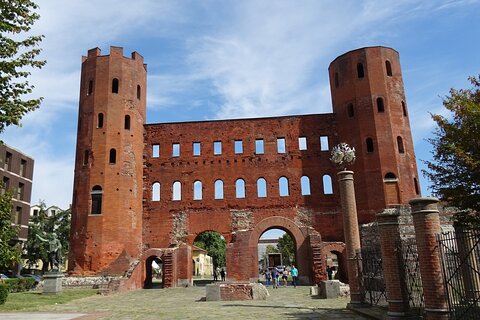
The Palatine Gate represents the primary archaeological evidence of the city's Roman phase, and is one of the best preserved 1st-century BC Roman gateways in the world. Together with the ancient theatre's remains, located a short distance away, it is part of the so-called Archaeological Park, opened in 2006.
Here you will have to look around to find the answer to our challenge to advance to the new location and learn the story of this place.
5
The Madama Palace, begun in the 13th century, owes its name to the resident widows of the 17th-century dukes of Savoy. Used by the Sardinian Senate in 1848–60 and by the Italian Senate in 1861–64, it now houses the Museum of Ancient Arts.
Here you will have to look around to find the answer to our challenge to advance to the new location and learn the story of this place.
6
Stop 6
Pass by
Piazza Castello is a city square in Turin, Italy lined with museums, theaters and cafes.
Here you will have to look around to find the answer to our challenge to advance to the new location and learn the story of this place.
7
The Palazzo Trucchi di Levaldigi is famous because of its massive wooden door, which was commissioned in the 17th century by the then Earl of Trucchi di Levaldigi
Here you will have to look around to find the answer to our challenge to advance to the new location and learn the story of this place.
8
Stop 8
Pass by
Piazza San Carlo is one of the main city squares in Turin, Italy. It was laid out in the 16th and 17th century and is an example of Baroque style. Its current name is an hommage to Charles Borromeo while the square was previously known as Piazza Reale, Piazza d'Armi, and Place Napoleon.
Here you will have to look around to find the answer to our challenge to advance to the new location and learn the story of this place.
9
Stop 9
Pass by
In Piazza Castello converge some of the main streets of the city centre. Among them, one of the most significant is the arcaded Via Po, built by Amedeo di Castellamonte in 1868 and featuring some interesting buildings, such as the first and original building of the University of Turin and the historical Caffè Fiorio.
Here you will have to look around to find the answer to our challenge to advance to the new location and learn the story of this place.
10
The 1 st church was built between 1648 and 1656 on a project of Carlo Morello. It was a single-nave church without external arcades. From 1683 the choir was enlarged and added two side chapels. . In the eighteenth century, important works of art were added to the interior of the church: the main altar of Bernardo Vittone, the altar and the balustrade of the Cappelle dell'Addolorata Francesco Martinez, support wood procession created by Beaumont da Giuseppe and Stefano Maria Clemente.
Here you will have to look around to find the answer to our challenge to advance to the new location and learn the story of this place.
11
Ponte Vittorio Emanuele I is the oldest existing bridge in Turin. In addition, it can also be called the most beautiful one, and most important. A crossing over the Po river in this place was of great importance for the city at all times. In the 15-19 centuries, it was one of the main gateways into the city.
Here you will have to look around to find the answer to our challenge to advance to the new location and learn the story of this place.
What's not included
A physical tour guide
Available languages
Written guide
EN
IT
FR
Reviews breakdown
Viator
1.0
1 reviews
5★
0
4★
0
3★
0
2★
0
1★
1
Tripadvisor
3.5
8 reviews
5★
5
4★
0
3★
0
2★
0
1★
3
Important information
Infants and small children can ride in a pram or stroller
Service animals allowed
Public transportation options are available nearby
Suitable for all physical fitness levels
Meeting point
Please use Google Maps or other map services to arrive at this location. When you arrive, please follow the instructions inside the Questo app closely.
Important notes
- Unlock your city game in the Questo app using this link: [https://questoapp.com/unlock](https://questoapp.com/unlock)
- Download the Questo app using this link (it’s free): [onelink.to/questo](http://onelink.to/questo)
- Head to the starting point and enjoy your city game!
About Turin, Piedmont & Liguria
Turin, the elegant capital of Piedmont, is renowned for its refined architecture, rich history, and as the birthplace of the Italian unification. Nearby Liguria offers stunning coastal landscapes, including the famous Cinque Terre. Together, they offer a blend of urban sophistication and natural beauty.
Top Attractions
Mole Antonelliana
Iconic symbol of Turin, now home to the National Cinema Museum.
Architecture
1-2 hours
€12
Cinque Terre
UNESCO-listed coastal villages with stunning hiking trails and beaches.
Nature
Full day
Free to explore, hiking passes available
Egyptian Museum
One of the world's most important collections of Egyptian artifacts.
Museum
2-3 hours
€17
Palazzo Reale
Former residence of the Savoy royal family, showcasing opulent interiors and historical artifacts.
Historical
1-2 hours
€12
Aquarium of Genoa
One of the largest aquariums in Europe, featuring a wide variety of marine life.
Entertainment
2-3 hours
€27
Must-Try Local Dishes
Agnolotti del Plin
Small stuffed pasta filled with meat, served with butter and sage sauce.
Dinner
Contains meat
Focaccia
Traditional Ligurian flatbread, often topped with olive oil and salt.
Snack
Vegetarian
Bagna Cauda
Warm dip made from garlic, anchovies, and olive oil, served with vegetables.
Dinner
Contains fish
Popular Activities
Hiking in Cinque Terre
Skiing in the Alps
Spa treatments
Beach lounging
Visiting museums
Attending festivals
Boat tours
Swimming in Ligurian beaches
Best Time to Visit
June to August, September to October
Perfect weather for exploring the city and coastal areas. Summer is peak tourist season with warm weather and numerous festivals.
15-30°C (59-86°F)
59-86°F
Practical Information
Language
- Official: Italian
- Widely spoken: English, French
- English: Moderately spoken
Currency
Euro (EUR)
Time Zone
GMT+1 (CET), GMT+2 (CEST during daylight saving time)
Electricity
230VV, 50HzHz
Safety Information
Overall Safety Rating: Generally safe
Turin and Liguria are generally safe, but standard precautions should be taken to avoid petty crime.
Important Precautions:
- • Keep valuables secure in crowded areas.
- • Use licensed taxis or ride-sharing apps.
- • Be cautious when using ATMs, especially at night.
Getting there
By air
- Turin Airport • 16 km (10 miles) from city center
- Christoforo Colombo Airport • 9 km (5.6 miles) from Genoa city center
By train
Turin Porta Nuova, Genoa Piazza Principe
By bus
Turin Bus Station, Genoa Bus Station
Getting around
Public transport
Efficient and easy to use, covering key tourist spots.
Taxis
Available • Apps: MyTaxi, FreeNow
Rentals
Car, Bike, Scooter
Neighborhoods
Quadrilatero Romano
San Salvario
Porto Antico
Day trips
Alba
100 km (62 miles) from Turin • Half day to full day
Charming town known for its truffles, wine, and medieval architecture.
Portofino
30 km (19 miles) from Genoa • Full day
Luxurious coastal town with stunning views and high-end shopping.
Alberobello
200 km (124 miles) from Genoa • Full day
Famous for its unique trulli houses, a UNESCO World Heritage site.
Festivals
Turin Film Festival • Late November
Settimana Santa • Holy Week
Pro tips
- Visit the Egyptian Museum early in the morning to avoid crowds.
- Take a day trip to Alba for truffle hunting and wine tasting.
- Explore the Cinque Terre villages by hiking for the best views and experiences.
- Try local specialties like agnolotti and focaccia for an authentic taste of the region.
- Use the Torino+Piemonte Card for unlimited public transport and museum access.
Get Price
per person
Price varies by option
Secure booking
Free cancellation available
Instant confirmation


