Colmar Audio Guided Walking Tour 2h10 and 21 Audio Comments
Active
2h
For a full refund, cancel at least 24 hours before the scheduled departure time.
Instant confirmation
Mobile or paper ticket accepted
About this experience
Colmar, nicknamed the "Little Venice", invites you to explore its 21 iconic sites in one day. From colourful half-timbered houses to picturesque canals, every corner of the city exudes Alsatian authenticity. Don’t miss Rapp Square, the Unterlinden Museum and the charm of the Little Venice district. This walking tour allows you to discover the wonders of Colmar while enjoying a glass of local wine after your visit.
- Walking tour of 4.7 km, suitable for all levels.
Explore 21 must-see sites, including the House of Heads and the Church of Dominicans.
- Perfect for families, couples and history lovers.
- Enjoy an interactive application to enrich your experience.
Available options
Audio guided circuit
What's included
Recommendations for the best photo opportunities
Immediate access to the audioguided circuit, no tickets or materials to collect
Offline mode (no data consumption during the visit)
3 languages available: French, English, Spanish
Text transcripts of all audio content
21 immersive audio comments along the way (History...)
Admire the hidden gems that lie off the beaten track
Interactive navigation with 3D map to discover the most beautiful streets,...
Detailed itinerary
1
Here you are in the central square of Colmar. Place Rapp is named after General Jean Rapp, a great political actor of the French Revolution hailed for his courage during the revolutionary wars. His statue is found in the center of the square, sculpted by the famous artist Auguste Bartholdi who owes the Statue of Liberty of New York. Just that!
2
Stop 2
Pass by
You are here between the two buildings that constitute the most famous museum in Colmar: Unterlinden. It is a Museum of Fine Arts, one of the most visited in France. It is divided between two buildings: the one on your left is a former 13th century convent.
3
Behind you is the Municipal Theatre. It was built between 1847 and 1849 by the architect Louis-Michel Boltz. In view of its success and the city’s growing population, it was enlarged in 1902 to accommodate more and more spectators.
4
A historic monument in Colmar, this water tower is a very fine example of 20th century German architecture. In 1886, the Swiss engineer Henri Grüner and the architect Jean-Baptiste-Victor Huen created this water tower to regulate the distribution of drinking water in the city.
5
Another emblematic monument of this small Alsatian town, here is the Circle Saint Martin. With a beautiful blend of Romanesque Revival and Gothic Revival, this 72-metre building along Joffre Avenue was built in the late 19th century to welcome men and children for cultural and sporting Things to do.
6
Stop 6
Pass by
Here you are in Little Venice, one of the most picturesque areas of Colmar! It is here at the rhythm of the canals that you discover the typical Alsatian houses, with their wooden sections painted in the colors of the region, arranged so that they remind us of those that can be seen in Venice.
7
Shopping street, but just as picturesque as the rest of Colmar, Grand Street is the center of the city. In this sense, it takes you straight to Place Jeanne d’Arc, where the Cattle Point of Sale used to be held, but especially public executions.
8
Built under the model of the Venetian palaces, this building called the House of the Knights of St. John was designed in the 17th century by the architect Albert Schmidt, who was responsible for several other private houses in the center of Colmar.
9
It is a set of bricks and metal frames that has housed the Colmar Covered Point of Sale since 1865. A historic building, then, thanks to the architect Louis-Michel Boltz, who also built the city’s municipal theatre a few years before the Point of Sale.
10
This wharf bears its name, since it is fishermen's houses that border the Lauch. Considered one of the most beautiful spots to admire the typical houses of Alsace, the quay of the Poissonnerie housed in the 16th century the fishermen who sold their fish here.
11
The rue des Tanneurs marks the entrance to the district of the same name. As the name suggests, this is where the tanners were at the time, who were allowed to work only on this street.
12
Stop 12
Pass by
Here you find yourself facing the old customs house of the city, called the Kofhus. With its recognizable green and yellow roof, it is the oldest public building in Colmar: built in 1480, it served as a warehouse, a place for the taxation of goods and a meeting place for Alsatian deputies and the magistrate.
13
Here is one of the most famous fountains in the city! Located opposite the Old Customs, this fountain is decorated with the statue of a 16th century Alsatian figure, Lazarus of Schwendi, who fought in Hungary against the Turks.
14
A little air of Brussels in the heart of Colmar! This replica of the famous Manneken Pis, installed on the façade of the Courthouse, dates from 1922 and was donated by Brussels to Colmar as a tribute to the common suffering that the two cities had to face during the German occupation.
15
At this crossroads are two iconic houses of the city. At the corner of rue Mercière and rue des Marchands, you will find Maison Pfister, certainly the most famous in Colmar.
16
Here you are in the Cathedral Square, but before turning your attention to the imposing Saint Martin Collegiate Church, I invite you to turn around and observe the buildings facing it.
17
Given the name of the square on which it stands, one might think that this church is Colmar Cathedral, but this is not the case. Not anymore, at least, since during the Revolution it had been elevated to cathedral status, but only for about ten years.
18
The construction of St Matthew’s Church, intended to be the Franciscan church of the city, began at the end of the 13th century. After the Lutheran Reformation, it was placed at the disposal of the Protestant cult for nearly two centuries, before being again assigned to the Catholic cult in 1715 by order of the King of France.
19
A true masterpiece of Gothic art, the Dominican Church was built from the 13th century on the current Martyrs of the Resistance Square. Rodolphe of Habsburg, king of the Romans, laid the foundation stone for the building.
20
It is a tribute to the watercolour artist and illustrator Jean-Jacques Waltz, known through his works as Hansi.
21
This building with such special architecture is called the House of the Heads, in reference to the 106 heads that adorn its impressive facade. Listed as Historic Monuments, it is one of the best known houses in Colmar.
What's not included
Entrance fees to paid establishments along the route...
Headphones or headphones (optional)
Available languages
Audio guide
EN
FR
ES
Important information
Service animals allowed
Public transportation options are available nearby
Suitable for all physical fitness levels
Meeting point
We build our circuits in the form of a loop so that you can easily start the tour at the point closest to you, the guidance will adapt automatically. If you are nearby, we recommend this ideal Check-out Point.
Important notes
Activating your audio-guided circuit:
1. Download the INWAY mobile app from your App Store or directly via this link: in-way.fr/app
2. Open the application and enter your code to unlock the circuit: COLM7352
We build our circuits in the form of a loop so that you can easily start the tour at the point closest to you, the guidance will adapt automatically. If you are nearby, we recommend an ideal Check-out Point: On Place Rapp
About Colmar
Colmar is a picturesque town in northeastern France, known for its well-preserved old town and charming canals. With its colorful half-timbered houses, cobbled streets, and flower-adorned bridges, it offers a unique blend of Alsatian and French culture.
Top Attractions
Petite Venise
Petite Venise, or Little Venice, is the most picturesque part of Colmar. This charming quarter features colorful half-timbered houses, flower-adorned bridges, and canals that create a romantic and enchanting atmosphere.
Historical
1-2 hours
Free
Musée Unterlinden
The Musée Unterlinden is one of the most important museums in the Alsace region. It houses a remarkable collection of art and artifacts, including the famous Isenheim Altarpiece, a masterpiece of Gothic art.
Museum
2-3 hours
€9 (free for under 18s and EU residents under 26)
Collégiale Saint-Martin
The Collégiale Saint-Martin is a beautiful Gothic church located in the heart of Colmar. The church features stunning stained glass windows, intricate carvings, and a rich history dating back to the 13th century.
Religious
30-45 minutes
Free (donations welcome)
Marché Couvert
The Marché Couvert is a covered market in Colmar offering a variety of local produce, cheeses, meats, and other regional specialties. It's a great place to sample Alsatian cuisine and shop for local products.
Market
30-60 minutes
Free to enter, prices vary by vendor
Musée Bartholdi
The Musée Bartholdi is dedicated to the life and work of Frédéric Auguste Bartholdi, the sculptor who designed the Statue of Liberty. The museum is housed in Bartholdi's family home and features a collection of his sculptures, drawings, and personal artifacts.
Museum
1-2 hours
€6 (free for under 18s and EU residents under 26)
Must-Try Local Dishes
Choucroute Garnie
A traditional Alsatian dish made with sauerkraut, sausages, and various cuts of pork, often served with potatoes or bread.
Main Course
Contains pork and gluten
Tarte Flambée
A thin, crispy flatbread topped with crème fraîche, onions, and bacon. It's a popular dish in the Alsace region and is often served as an appetizer or a light meal.
Appetizer or Main Course
Contains gluten and dairy
Baeckeoffe
A hearty Alsatian casserole made with layers of marinated meat (usually pork, beef, and lamb), potatoes, onions, and vegetables, slow-cooked in a ceramic dish.
Main Course
Contains pork, beef, and lamb
Kougelhopf
A traditional Alsatian brioche-like cake made with raisins, almonds, and sometimes candied fruits. It's often served for breakfast or as a dessert.
Dessert
Contains gluten, dairy, and nuts
Popular Activities
Hiking in the Vosges Mountains
Biking through the Alsace countryside
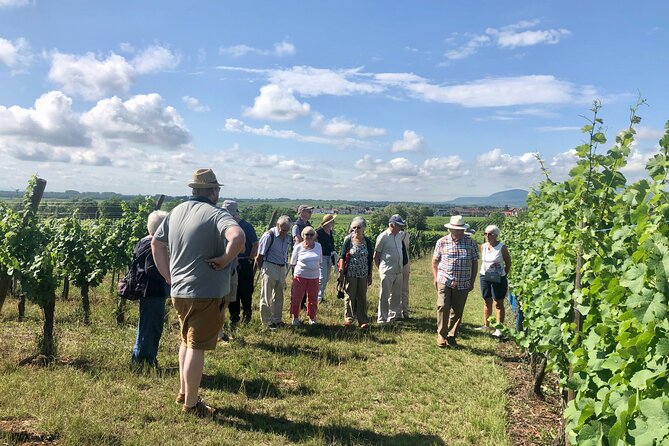
Wine tasting in local vineyards
Boat tours on the canals
Visiting museums and historic sites
Attending local festivals and events
Swimming in nearby lakes
Skiing and snowboarding in the Vosges Mountains
Best Time to Visit
June to August
Summer is the peak tourist season in Colmar, with pleasant weather and numerous outdoor events. The town is vibrant with visitors, and the gardens and canals are in full bloom.
15°C to 25°C
59°F to 77°F
Practical Information
Language
- Official: French
- Widely spoken: Alsatian (dialect of German), English
- English: Moderately spoken
Currency
Euro (EUR)
Time Zone
GMT+1 (Central European Time)
Electricity
230VV, 50HzHz
Safety Information
Overall Safety Rating: Generally safe
Colmar is generally a safe destination for travelers. Petty crime, such as pickpocketing, can occur in crowded tourist areas, so it's important to be vigilant and keep valuables secure.
Important Precautions:
- • Be vigilant in crowded areas
- • Keep valuables secure
- • Use metered taxis or agree on a price beforehand
Getting there
By air
- EuroAirport Basel-Mulhouse-Freiburg • 65 km from Colmar
- Strasbourg Airport • 65 km from Colmar
By train
Colmar Station
By bus
Colmar Bus Station
Getting around
Public transport
The bus network in Colmar is efficient and covers most of the town. Buses are a convenient way to get around, especially for visitors staying outside the town center.
Taxis
Available • Apps: Uber, Taxi Colmar
Rentals
Car, Bike, Scooter
Neighborhoods
Old Town
Neuf-Brisach
Turckheim
Day trips
Eguisheim
15 km from Colmar • Half day
Eguisheim is a charming medieval village known for its picturesque streets, historic architecture, and wine production. It's a great place to explore the Alsace wine region and enjoy the scenic countryside.
Riquewihr
20 km from Colmar • Half day
Riquewihr is a beautifully preserved medieval village known for its colorful half-timbered houses, narrow streets, and wine production. It's a great place to experience the charm of the Alsace region.
Strasbourg
65 km from Colmar • Full day
Strasbourg is the capital of the Alsace region and a vibrant city with a rich history. It's known for its stunning architecture, including the Gothic cathedral, and its charming old town, La Petite France.
Festivals
Christmas Markets • Late November to late December
Fête de la Saint-Nicolas • Early December
Fête de la Musique • June 21
Pro tips
- Visit Petite Venise during the early morning or late afternoon for the best photos and fewer crowds.
- Try local specialties like choucroute garnie, tarte flambée, and baeckeoffe at traditional Alsatian restaurants.
- Take a boat tour of the canals to see the town from a different perspective.
- Explore the charming villages of the Alsace region, such as Eguisheim and Riquewihr, for a unique and authentic experience.
- Visit the Musée Unterlinden to see the famous Isenheim Altarpiece, a masterpiece of Gothic art.
Get Price
per person
Price varies by option
Secure booking
Free cancellation available
Instant confirmation