Pompeii & Herculaneum Family Adventure | Guide+Transport+Tickets
Active
8h
For a full refund, cancel at least 24 hours before the scheduled departure time.
Instant_then_manual confirmation
Mobile or paper ticket accepted
About this experience
Visit both Pompeii and Herculaneum in one engaging day, with private transport, skip-the-line tickets, and a dedicated licensed guide. Designed especially for families with kids (ages 6–11), this tour turns archaeology into adventure with activity maps, stickers, riddles, and games that make the ruins feel alive while still covering all the major highlights. Parents enjoy a true deep-dive into temples, theaters, private homes, and ancient streets, while children learn through play and storytelling. Optional upgrade with traditional Neapolitan pizza lunch available.
Highlights:
• Private guided tours of Pompeii & Herculaneum
• Skip-the-line tickets + private luxury transport
• Family-friendly guide with interactive educational materials
• Flexible pace + personalized itinerary
• Optional Neapolitan pizza lunch
• Ideal for families, first-time visitors & cruise guests
• Educational, fun, and memorable for ages 6–11
Available options
Guide, Transport and Tickets
Family Guided Tour: Private tours in both archaeological sites, featuring our special “4kids” activities designed for children aged 6 to 12.<br/>Mercedes Minivan: Clean, comfortable, A/C<br/>Skip-the-Line Tickets: Pompeii and Herculaneum admission fee included<br/>Pickup included
Guide,Transport,Tickets&Pizza
Family Guided Tour: Private tours in both archaeological sites, featuring our special “4kids” activities designed for children aged 6 to 12.<br/>Pizza lunch: Neapolitan Pizza and one Drink of choice<br/>Mercedes Minivan: Clean, comfortable, A/C<br/>Skip-the-Line Tickets: Pompeii and Herculaneum admission fee included<br/>Pickup included
What's included
Blue Badge private guide in Pompeii and Herculaneum
Family-Friendly Activities, Booklet and Map
Only if the Pizza Lunch Option has been selected
Transport by private vehicle
Herculaneum and Pompeii Express skip-the-line tickets
Detailed itinerary
1
Stop 1
Your day begins in Herculaneum, the smaller but astonishingly well-preserved sister city at the base of Mt. Vesuvius. Unlike Pompeii, which was buried under ash and pumice, Herculaneum was overtaken by a superheated volcanic surge that carbonized wood, sealed upper floors, and protected entire streets almost intact. The result is extraordinary: painted walls, wooden beams and doors, furniture, mosaics, and everyday objects survive with a level of detail that feels almost unreal.
As you explore arcades, townhouses, and the ancient shoreline, your private guide will show how daily life in a wealthy Roman seaside community unfolded—where families dined, where merchants worked, and how residents navigated their city. Because Herculaneum is compact and far less crowded, it’s easier for both adults and kids to imagine real people moving through these spaces 2,000 years ago. Many travelers find Herculaneum to be the emotional highlight of the day: vivid and incredibly well-preserved.
2
Stop 2
Pass by
We will see the volcano from the bottom. You can take great pictures from Pompeii and from Herculaneum. We are not going to drive to the top of the volcano.
3
Your private guide will take your family into the Boat Pavilion, where a Roman vessel and maritime equipment were discovered. Kids enjoy imagining fishermen and sailors preparing to leave the little harbor, while adults learn how Herculaneum was connected to trade and travel by sea. Seeing a real boat preserved for nearly 2,000 years makes it easier to understand the town as a functioning port rather than just an archaeological site.
4
Inside the Antiquarium your guide will highlight objects that survived the eruption in extraordinary condition, including pieces of carbonized wood from furniture, doors, beams, and even shelves. Kids are amazed to discover that wood can survive for centuries when sealed by volcanic material, while adults learn why Herculaneum’s unique burial conditions preserved materials that almost never survive in archaeology. It’s an eye-opening stop that reveals the intimate domestic details of ancient life.
5
Your guide will lead your family down to the ancient shoreline, helping you picture Herculaneum as a seaside town where boats were pulled ashore and goods arrived from across the bay. In 1980, archaeologists found over 300 skeletons inside the boathouses here—men, women, and children who sought to escape by sea during the eruption. Kids grasp the geography and sea-level changes, while adults appreciate how this discovery transformed our understanding of the final moments of 79 AD. The guide handles this section sensitively so families can absorb the human story at their own pace.
6
Your private guide will explore this elegant seafront villa, famous for its marble sculptures of deer attacked by dogs. Kids enjoy imagining the dramatic garden scene, while adults learn about Roman luxury, sea views, and leisure culture. With its terraces overlooking the ancient coastline, the House of the Deer shows how Herculaneum’s wealthy residents blended art, nature, and relaxation in their daily lives.
7
Your private guide will walk you through Herculaneum’s large exercise courtyard, once used by young citizens for athletic training and social life. Surrounded by porticoes and overlooked by classrooms, this space wasn’t just about sport — it was where future elites learned rhetoric, fitness, and discipline. As you cross the vast open field, your guide will help you picture boys running drills, teachers observing from the shade, and festivals or public events held on special days. The scale of the complex reminds you how important physical and civic education were in Roman society, and how much pride the town invested in its youth.
8
Your private guide escorts you into one of Herculaneum’s most celebrated residences, reopened after decades of restoration. Inside, exquisitely preserved wall paintings, wooden shutters, and upper-floor structures reveal what Roman domestic life really looked like. Your guide highlights the elegant décor, private family rooms, and the careful restoration work that brought this home back to life. It’s a rare chance to experience an ancient house across multiple levels—almost as if its residents had just stepped out moments before.
9
Your private guide brings you to this ancient shop, recognizable by its rows of terracotta jars (cucumae) set into a marble counter. Here, residents once bought food and drinks much like at a modern café or takeaway. Your guide points out traces of storage jars, serving spaces, and even the original wooden shelving that survived the eruption—a vivid reminder of daily commerce in the Roman world.
10
Your private guide brings you into one of Herculaneum’s most elegant homes, famous for its vibrant mosaic panel of Neptune and Amphitrite. The scene still shines with deep blues and golden glass tesserae, giving you a rare glimpse of how sophisticated—and colorful—Roman interiors once were. From the dining area to the painted walls and fountain niche, your guide helps you imagine the house during lively banquets, when guests gathered to eat, drink, and show off status through art and décor.
11
Your private guide leads you through the women’s section of the public baths, remarkably preserved thanks to the rapid burial of the city. Here you’ll see benches, painted walls, and even wooden shelving that survived the eruption. Your guide explains how these baths worked as both a hygiene ritual and a social space, where women gathered to relax, exchange news, and prepare for the day. You’ll step into the changing room, then into the warm and hot rooms where steam once filled the air—an intimate glimpse into everyday life in the ancient Roman world.
12
Your private guide takes you inside this richly decorated hall dedicated to the cult of the Emperor. Brilliant frescoes show mythological scenes and offer a striking glimpse into how religion, civic life, and imperial politics blended in Roman society. As your guide explains the role of the Augustales—a prestigious local group of freedmen—you’ll gain a deeper understanding of the city’s social hierarchy and cultural life. It’s one of Herculaneum’s most atmospheric spaces, where vivid colors and crisp details make the ancient world feel startlingly close.
13
After Herculaneum, your private guide will take you to Pompeii, the famous Roman city frozen by the eruption of 79 AD. Depending on the day and season, your guide may suggest visiting in the afternoon when the site is often less crowded—making it easier for families to explore at a comfortable pace. However, the itinerary is always flexible and can be adjusted to your preferences or cruise schedules.
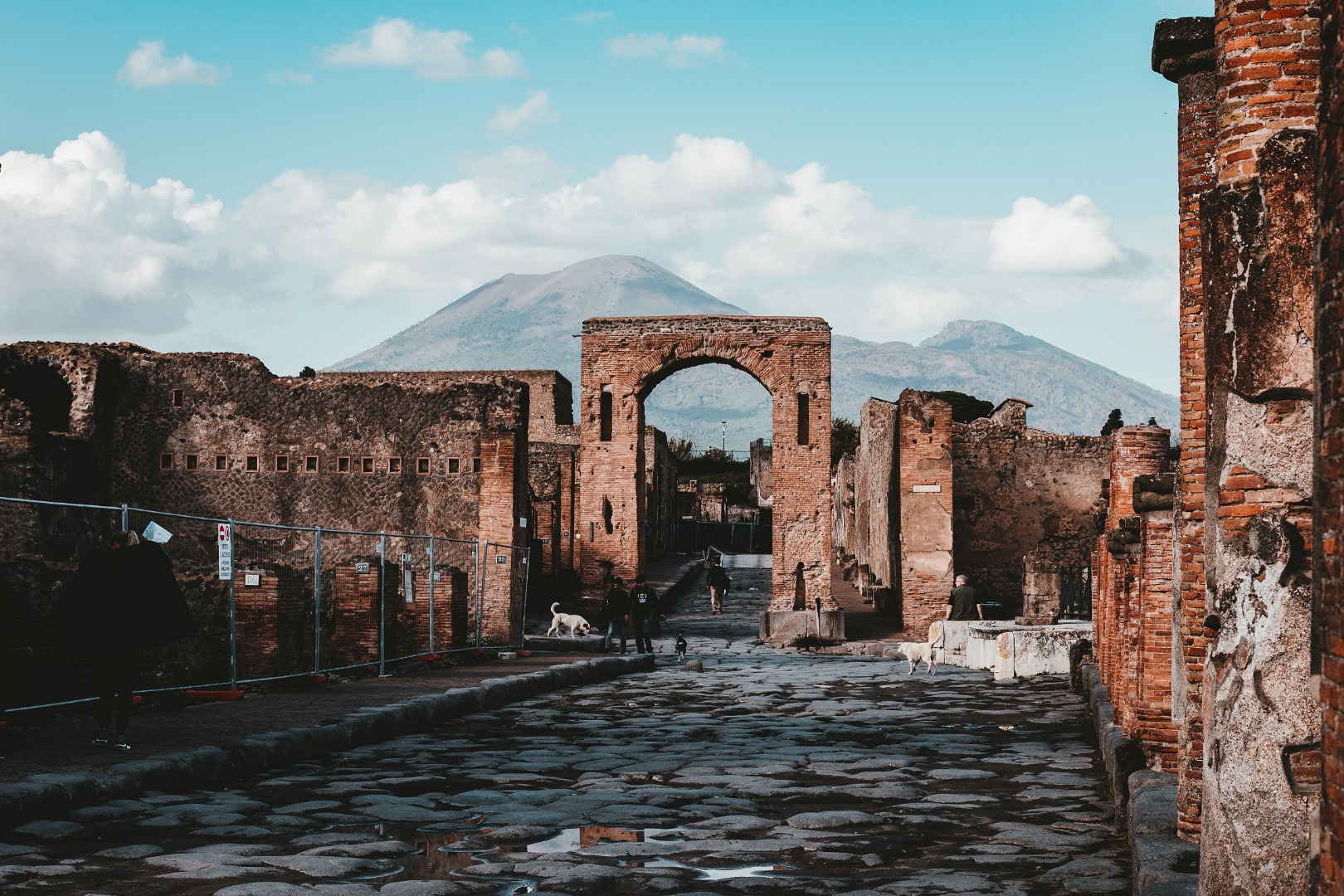
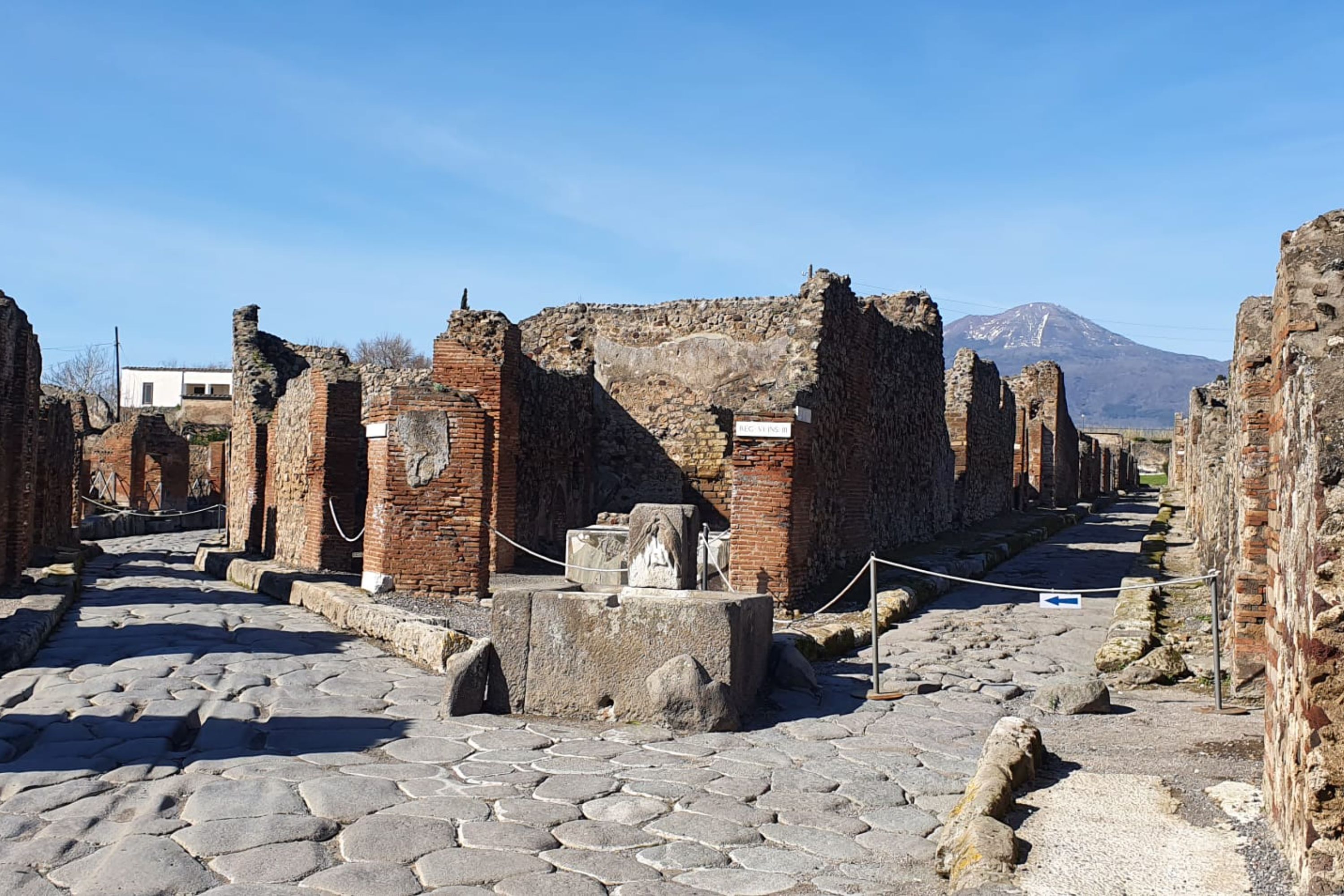
Pompeii is expansive and full of surprises: temples, theaters, bath complexes, bakeries, villas, and busy streets still marked by ancient cart tracks. Your guide brings it to life through storytelling and hands-on activities that keep kids engaged—solving riddles, spotting ancient symbols, matching stickers to locations, and discovering how Romans lived, worked, cooked, prayed, and played. Adults enjoy a true archaeological experience while children learn through curiosity and movement, turning the ruins into a giant open-air classroom.
14
Your private guide will lead you through Porta Marina, one of Pompeii’s main gateways, where merchants and sailors once entered from the port. As you pass beneath the stone arch and along the ancient walls, your guide will help you picture the city as it was on the morning of the eruption—busy streets, market chatter, and goods arriving from across the Mediterranean. It’s an ideal starting point to understand the scale of Pompeii before exploring its heart.
15
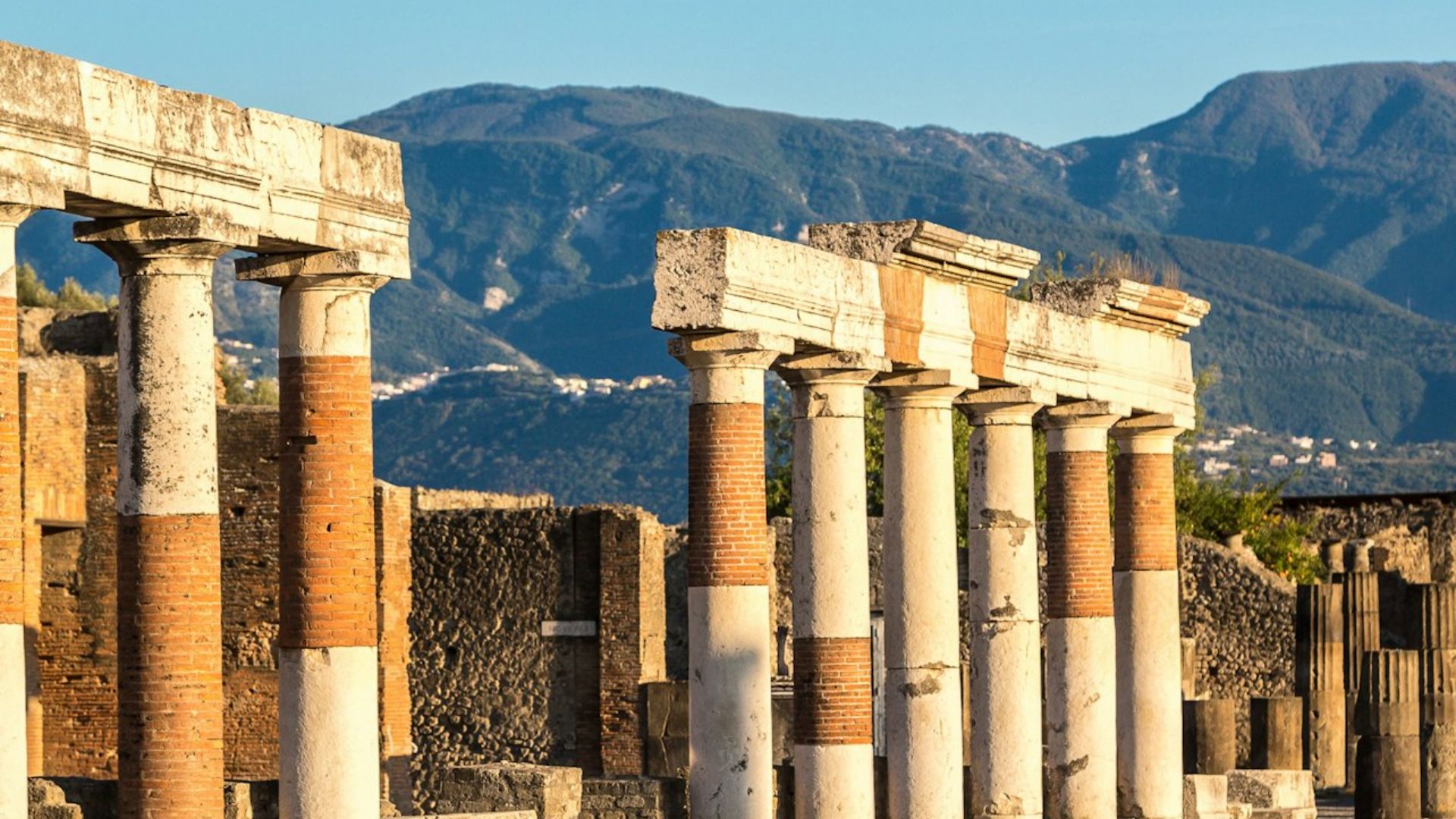
From the entrance, your guide will take you into the Basilica, the city’s most important civic building. Here is where legal disputes were heard, contracts agreed, and business negotiated long before paper and signatures existed. Walking among the surviving columns, your guide will show how the architecture reveals the influence of Rome, and how this space shaped daily life in Pompeii. Even without its roof, the building still conveys authority.
16
Stop 16
Pass by
Your guide will explore the Temple of Apollo, one of Pompeii’s most important religious spaces. Kids enjoy imagining priests performing ceremonies and spotting the statues of Apollo and Diana, while adults learn how religion influenced politics and identity in Roman society. From the temple terrace your family can also admire a clear view toward Mt. Vesuvius — a striking reminder of the volcano that changed everything in 79 AD. It’s a powerful moment where history and landscape come together in a single frame.
17
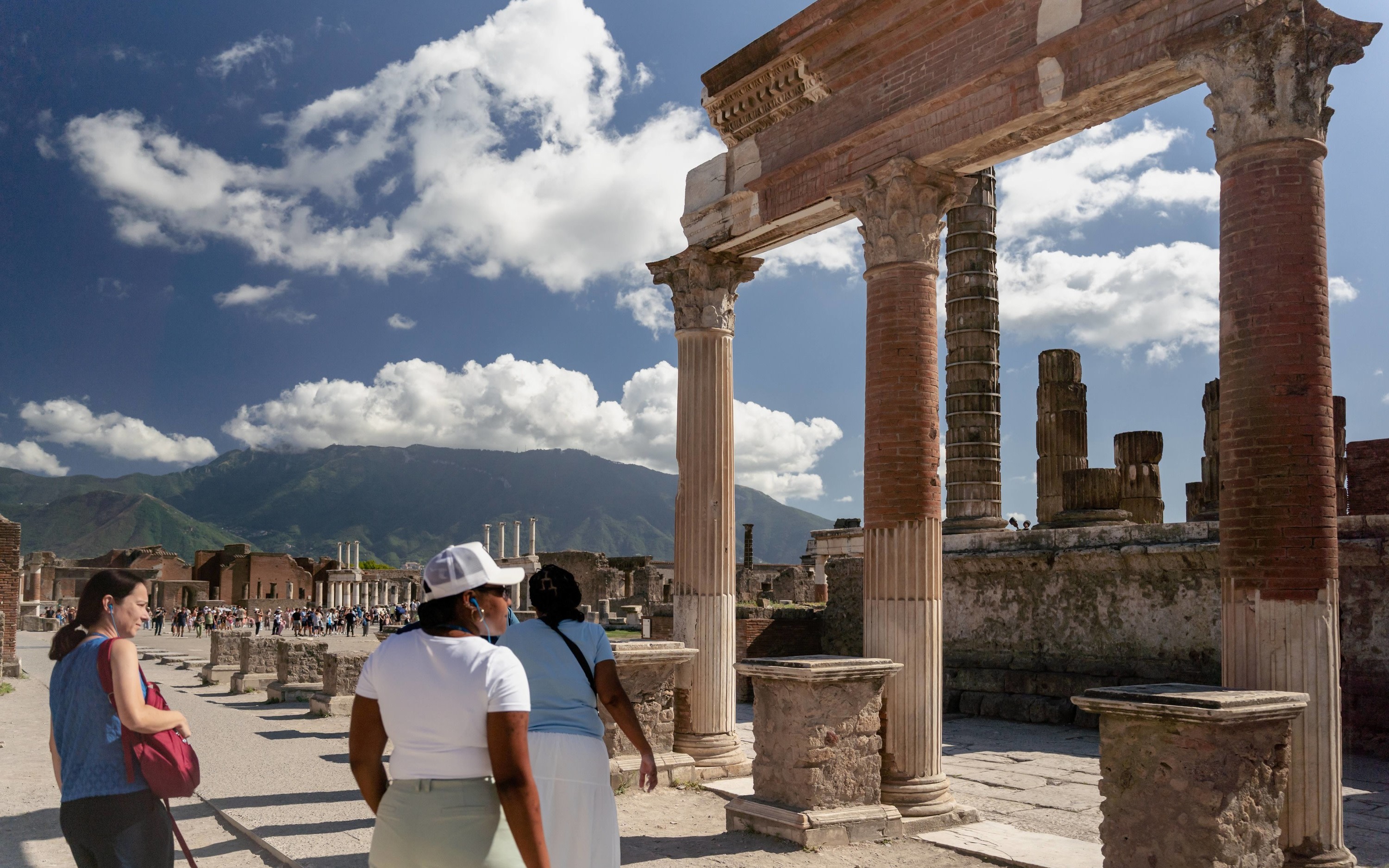
Your guide will bring the Forum to life as the beating heart of Roman Pompeii. This was where business deals were struck, religious ceremonies took place, and political speeches echoed through the square. Kids are invited to imagine the noise of vendors, priests, and citizens moving between temples and markets, while adults learn how Roman cities were organized around civic identity and public life. Surrounded by monumental buildings, your family gains a clear picture of Pompeii as a functioning community — a place of work, worship, debate, and daily routine.
18
Your private guide will lead you through Pompeii’s bustling ancient marketplace, the Macellum—where citizens once shopped for meat, fish, fruit, and imported delicacies. Kids love imagining the stalls full of food and vendors calling out prices, while adults discover how trade and everyday business kept the city running. Your guide will point out marble counters, storage vessels, and decorative elements that reveal what Romans bought, sold, and ate nearly 2,000 years ago. It’s one of the best places to picture Pompeii as a living, thriving city rather than just a ruin.
19
Your private guide will take you into the beautifully preserved Forum Baths, where ancient Romans came to wash, relax, and catch up with friends. Together you’ll walk through the changing rooms and heated bathing areas, and even admire original mosaics and stucco decorations that survived the eruption. Kids love comparing the baths to modern spas or sports clubs, while your guide explains how bathing was part of daily life — a mix of hygiene, exercise, and social time. It’s a fun and vivid stop that helps everyone imagine Pompeii as a real, living city.
20
Your private guide will lead your family into one of Pompeii’s grandest aristocratic homes, famous for its elegant gardens and intricate mosaics. Here you’ll learn how wealthy Roman families entertained guests, decorated their residences, and showcased their status through art. Kids enjoy spotting the small bronze statue of the dancing faun—almost like the “mascot” of the house—while adults appreciate the impressive mosaic floor depicting Alexander the Great in battle. Walking through courtyards, dining rooms, and private spaces gives everyone a vivid sense of how the elite lived behind closed doors nearly 2,000 years ago.
21
Your private guide will take your family through the beautifully restored House of the Vettii, famous for its vivid frescoes and refined garden courtyard. Kids enjoy spotting mythological scenes painted like ancient story panels — heroes, gods, and dramatic creatures all bursting with color — while adults learn how the Vettii brothers rose to wealth and used art to express culture and status. The preserved layout of dining rooms, service spaces, and private chambers makes it surprisingly easy to imagine household life unfolding between meals, work, and leisure.
22
Stop 22
Pass by
Your guide will walk your family along Pompeii’s liveliest ancient street, once lined with bakeries, bars, and storefronts catering to locals and travelers. Kids enjoy hopping across stepping stones and imagining carts rattling over the basalt pavement, while adults learn what Pompeians bought, sold, and ate as part of everyday life. Along the way, your guide points out street fountains, shop counters, and signage that make Pompeii feel surprisingly familiar — a city full of errands, routines, and midday snacks!
23
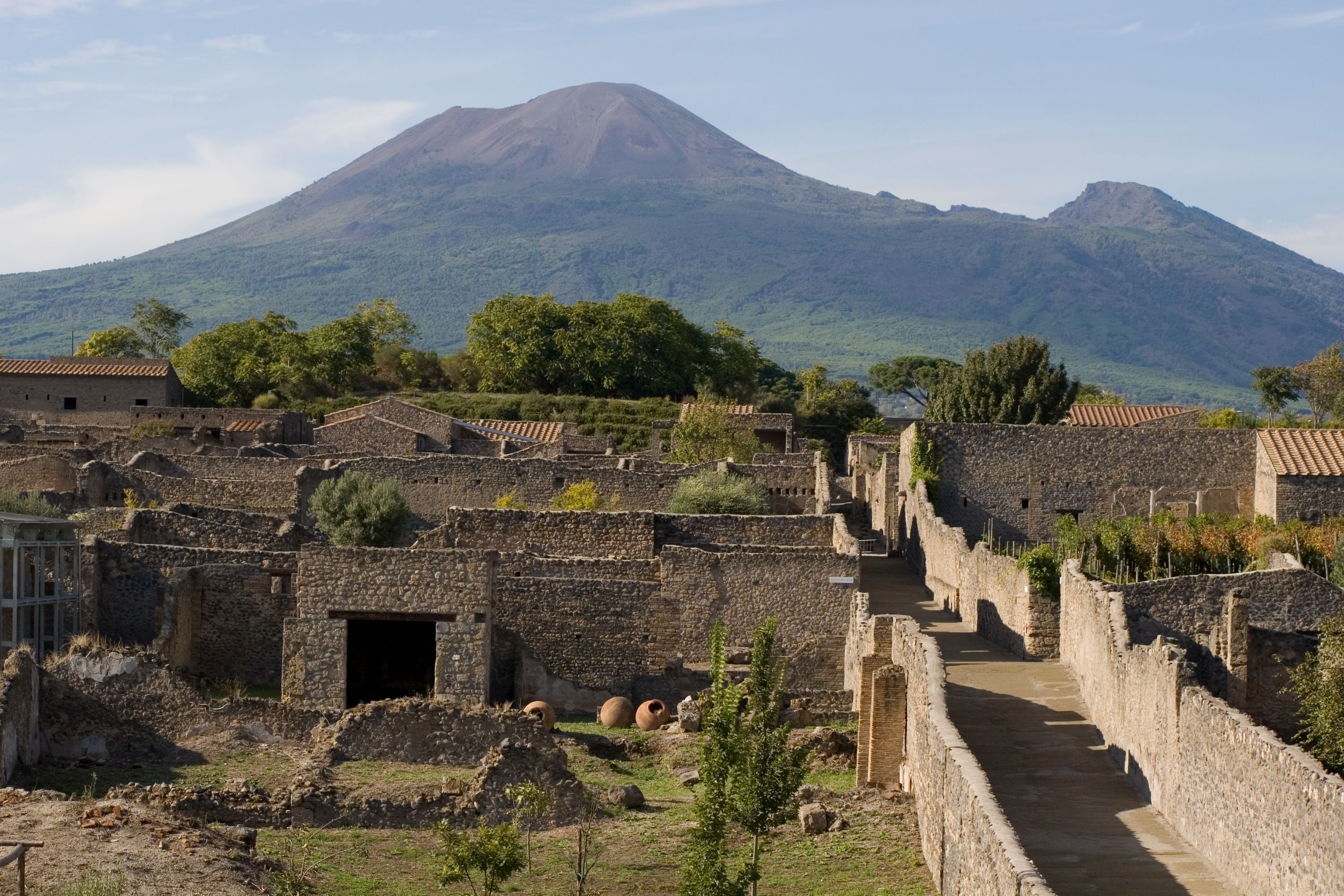
From a raised platform, your guide will offer an extraordinary bird’s-eye view into an entire Pompeian city block. Kids love the “dollhouse effect,” seeing rooms without roofs and imagining people moving through kitchens, workshops, and dining areas. Adults discover how archaeologists interpret these spaces to reconstruct daily routines — where food was prepared, where families slept, and how businesses operated. This elevated perspective also reveals how densely the ancient city was built, with homes, shops, and courtyards packed together behind the street façades.
24
Stop 24
Pass by
Your guide will lead your family into Pompeii’s main theater, built directly into the hillside to amplify sound. Kids enjoy testing the ancient acoustics from the stage (“can you hear me up there?”), while adults learn how public entertainment — from comedies to musical performances — played a major role in Roman culture. Seated on the stone steps, it becomes easy to imagine audiences gathering in the afternoon shade, cheering their favorite performers and gossiping between acts. It’s a rare stop where ancient and modern habits feel almost identical.
25
Your guide will take your family through the Antiquarium, where real artifacts recovered from the excavations help connect the ruins to the people who lived here. Jewelry, coins, tools, and household objects reveal the personal side of the city — how people worked, worshiped, decorated their homes, and expressed themselves. Kids enjoy recognizing items they’ve seen in the ruins (“we saw that in the bakery!”), while adults appreciate the curated displays of everyday materials. The plaster casts of eruption victims are introduced sensitively, giving families space to understand the human story behind the archaeology without overwhelming younger children.
What's not included
Bottled water
Available languages
Guide guide
EN
IT
FR
ES
Written guide
EN
Reviews breakdown
Viator
5.0
1 reviews
5★
1
4★
0
3★
0
2★
0
1★
0
Tripadvisor
5.0
14 reviews
5★
14
4★
0
3★
0
2★
0
1★
0
Important information
Infants and small children can ride in a pram or stroller
Service animals allowed
Specialized infant seats are available
Not recommended for travelers with spinal injuries
Not recommended for pregnant travelers
Not recommended for travelers with poor cardiovascular health
Travelers should have at least a moderate level of physical fitness
Comfortable walking shoes and sun block are recommended
About Pompeii
Pompeii is an ancient Roman city near modern-day Naples, famously preserved by volcanic ash from the eruption of Mount Vesuvius in 79 AD. It offers a unique glimpse into Roman life, with remarkably well-preserved ruins and artifacts. The site is a UNESCO World Heritage Site and one of the most visited archaeological sites in the world.
Top Attractions
Pompeii Archaeological Park
The main attraction in Pompeii, this vast archaeological site preserves the ruins of the ancient Roman city buried by the eruption of Mount Vesuvius in 79 AD. It offers a unique glimpse into Roman life and architecture.
Historical
3-5 hours
€18 (full price ticket)
Mount Vesuvius
The volcano that famously destroyed Pompeii offers a scenic hike with panoramic views of the Bay of Naples. The crater is accessible via a short walk from the summit.
Nature
2-3 hours
€10 (entry fee)
Villa of the Mysteries
One of the most famous villas in Pompeii, known for its well-preserved frescoes depicting mysterious rituals. The villa offers insight into the daily life and beliefs of the ancient Romans.
Historical
30-45 minutes
Included in the general admission ticket
Must-Try Local Dishes
Pizza Margherita
A classic Neapolitan pizza topped with tomato sauce, mozzarella cheese, and fresh basil. It is a must-try in the region.
Lunch/Dinner
Contains dairy and gluten
Spaghetti alle Vongole
A traditional Italian dish made with spaghetti, clams, garlic, white wine, and parsley. It is a popular seafood dish in the region.
Lunch/Dinner
Contains seafood and gluten
Sfogliatella
A traditional Neapolitan pastry filled with sweet ricotta cheese and candied fruit. It is a popular dessert in the region.
Dessert
Contains dairy and gluten
Popular Activities
Hiking Mount Vesuvius
Biking in the surrounding countryside
Beach visits in nearby coastal towns
Wine tasting in local vineyards
Visiting museums and historic sites
Attending local festivals and events
Boat tours in the Bay of Naples
Visiting nearby ski resorts
Best Time to Visit
April to June, September to October
The peak season offers comfortable temperatures and fewer crowds compared to the summer months. The weather is ideal for exploring the ruins.
15°C to 28°C
59°F to 82°F
Practical Information
Language
- Official: Italian
- Widely spoken: English, Neapolitan
- English: Moderately spoken
Currency
Euro (EUR)
Time Zone
GMT+1 (Central European Time)
Electricity
230VV, 50HzHz
Safety Information
Overall Safety Rating: Generally safe
Pompeii is generally safe for tourists, but pickpocketing and petty theft can occur in crowded areas. It is important to be aware of your surroundings and take precautions to protect your belongings.
Important Precautions:
- • Keep valuables secure and out of sight
- • Use licensed taxis or ride-sharing services
- • Be cautious of strangers approaching you with petitions or requests for money
Getting there
By air
- Naples International Airport • 20 km (12 miles)
By train
Pompeii Scavi - Villa dei Misteri Station
By bus
Naples, Sorrento, Salerno
Getting around
Public transport
Buses are available in the modern town of Pompeii, but the archaeological site is best explored on foot.
Taxis
Available • Apps: Uber, FreeNow
Rentals
Car, Bike, Scooter
Neighborhoods
Pompeii Town
Ancient Pompeii
Day trips
Naples
25 km (15 miles) • Full day
Naples is a vibrant city known for its rich history, art, and culture. It offers a variety of attractions, including museums, churches, and historic sites.
Sorrento
20 km (12 miles) • Full day
Sorrento is a charming coastal town known for its beautiful views, lemon groves, and traditional crafts. It offers a variety of attractions, including beaches, shops, and restaurants.
Herculaneum
15 km (9 miles) • Half day
Herculaneum is an ancient Roman town that was also buried by the eruption of Mount Vesuvius in 79 AD. It offers a unique glimpse into Roman life and architecture.
Festivals
Festa di San Gennaro • September 19
Pompeii Wine Festival • May
Napoli Teatro Festival • June to July
Pro tips
- Arrive early to the archaeological site to beat the crowds and the heat
- Wear comfortable shoes and bring water and sun protection
- Consider hiring a guide or using an audio guide for a deeper understanding of the site
- Try traditional Neapolitan pizza and other local dishes in Pompeii and the surrounding region
- Visit nearby attractions, such as Naples, Sorrento, and Herculaneum, for a more comprehensive experience
Get Price
per person
Price varies by option
Secure booking
Free cancellation available